Office furniture design trends for 2026

Written by
Gareth Van Zyl
Contents
Furniture is no longer simply an afterthought or the final layer applied after “the workplace strategy” is decided. In 2026, office furniture design is a strategy in its own right, and one where intent becomes physical, measurable, and hard to ignore.
The measurements for what makes a good place to work have changed. It’s no longer about creating an office environment that’s just functional. The contemporary office considers an individual's experience: Can people do focused work without friction? Do they feel included and comfortable? Can teams collaborate without draining energy? And does the workplace support wellbeing, sustainability and performance in ways employees can actually feel day to day?
That’s why office furniture design trends 2026 aren’t really about looks. They’re about behaviour, outcomes, and lifecycle value. This guide will break down the design trends we expect to see more of in 2026, from the return of the desk in the office workplace, the impact of AI, to a shift to neuro-inclusive furniture design and more.
If you are ready to give your workplace a makeover for 2026, our furniture consultancy services can help ensure you choose the right office furniture to support your workforce and complement your branding.

1) From hybrid theory to real behaviour: how people actually use offices
The most outdated lens in workplace planning is the binary: “collaboration office” vs “focus home.” Real office life is more nuanced.
People come into work for a wide variety of reasons, such as:
Focus (when home isn’t suitable, or when being in a structured workplace environment is more helpful to the task at hand).
Mentoring and learning (this is particularly true when it comes to early-career development)
Collaboration (this can be both for larger meetings and for small breakout groups, where meeting face-to-face can help foster creativity, iron out problems, and help keep employees on task).
Routine and belonging (the social and psychological anchors of work).
Workplace behaviour research and attendance patterns discussed across workplace networks consistently point to an important truth: usage is uneven and situational, it varies by team, role, project phase, and even time of day.
What this means for furniture in 2026
Office furniture design trends now prioritise choice without forcing behaviour. The goal isn’t to manipulate teams into collaborative working by removing desks, or to “make people focus” by building silent zones no one uses. Instead, furniture must:
Offer multiple postures and settings for the same person across a day
Be dynamic enough to enable quick switching between solo work, quick 1:1s, and small group tasks
Support routine (predictability, availability, personal comfort) while still allowing for the flexibility that many modern workplaces require.
In practical terms, the 2026 furniture specification is moving towards balanced ecosystems: desk zones that people trust, plus small-scale collaboration and mentoring settings that are easy to use, without turning the whole office into a meeting room.

2) The return of the desk (reimagined for 2026)
One of the biggest office furniture trends is also one of the simplest: the desk is back, but not as a static, one-size-fits-all bench.
Across many organisations, “blanket hot-desking” has created avoidable friction:
People lose time setting up each day
Ergonomics becomes inconsistent
Storage becomes an issue
It subtly signals that presence is temporary and replaceable
Offices do not have enough desks to accommodate all staff
In 2026, the desk returns in two common forms:
Dedicated desks (for roles with high individual output or specialist setups)
Semi-dedicated neighbourhoods (teams have a “home zone,” desks are shared within a smaller group)
Why the desk is evolving
AI-supported workflows and screen-heavy tasks are changing what “good desk setup” means. People are using (and therefore expecting):
Dual monitors for complex tasks
Better video setups
More peripherals
More charging and power adapters
More time in cognitively demanding work sessions
That makes desk design an infrastructure decision, not just a furniture selection.
Ergonomics is becoming baseline, not premium
Expect height-adjustable desks to no longer be seen only in the most forward-thinking office designs, but to become a baseline expectation.
As organisations align with recognised ergonomic principles and standards, such as referencing standards from the British Standards Institution (BSI) (including BS EN 1335 for office seating ergonomics) and professional guidance from the Chartered Institute of Ergonomics & Human Factors, the adoption of ergonomic furniture in the workplace will only become more widespread.
While seating standards are often referenced more directly than desk standards, the wider point holds: 2026 specs increasingly require documented ergonomic performance, not just aesthetic alignment.
Desk and workstation trends to consider in 2026
Power-first planning: more power, better cable management, and clearer maintenance access
Monitor-friendly geometry: deeper work surfaces, better sightline planning, and accessory rails
Storage that supports semi-dedication: personal lockers, under-desk storage, or shared pedestals
Acoustic and visual moderation: modesty panels, screens, or spatial zoning to reduce distraction
“Home-equivalent” setups: acknowledging that people compare the office to the comfort and control they have at home
Workplace experience research, such as the Leesman Index, continues to be widely used to connect workplace inputs (such as workspace variety and individual work support) to reported employee experience and perceived productivity. The takeaway for desks is straightforward: when individual work is hard to do in the office, the office becomes optional.
Our guide to ergonomic furniture beyond aesthetics provides a deeper look at how adjustable, flexible office furniture can support your workplace needs.
3) Seating evolves from comfort to cognitive support
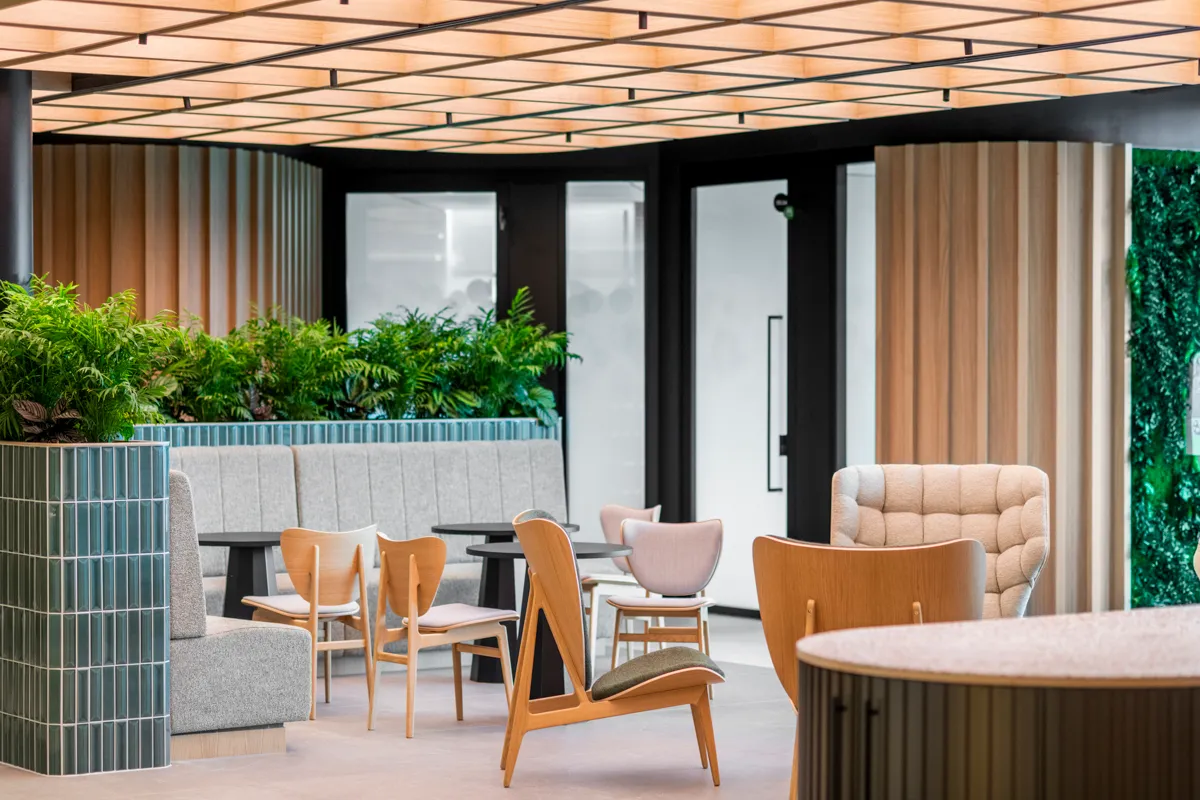
In 2026, seating is not just about comfort. It’s also about cognitive load, inclusion, and sustained performance.
Seating has long been the “big ticket” line item, but the next wave of office furniture design trends 2026 treats seating as a system: task seating, focus seating, lounge seating, and perching, all with different cognitive and sensory effects.
Trend 1: Highly adjustable task seating becomes standard
Adjustability is moving from specialist to standard because hybrid work exposed inconsistency: people may
be in the office fewer days, but they still need those days to be physically and mentally sustainable.
Expect specifications to emphasise:
Seat depth and lumbar adjustability
Arm adjustability that works with typing and video calls
Support across longer focus sessions, not just short stints
Ergonomics guidance and human factors thinking from organisations such as the Chartered Institute of Ergonomics & Human Factors reinforce that discomfort and poor posture aren’t just physical risks; they can increase cognitive load and reduce performance.
Trend 2: Neuroinclusive seating choices
It is vitally essential for workplaces to build and adapt office environments to accommodate a range of neurodiverse needs to truly create an inclusive workplace. In the case of furniture design and procurement, this means providing seating and micro-environments that accommodate different sensory needs and attention styles.
Research and practice knowledge shared through centres such as the Centre for Neurodiversity at Work at City, University of London is part of a growing body of work encouraging employers to reduce unnecessary sensory stressors and provide more supportive environments.
In furniture terms, that means offering:
Options with higher side panels or hooded seating for reduced visual stimulation
Softer, less reflective materials in certain zones
Choice of firmness, posture (upright vs relaxed), and enclosure
Our article on designing a neuroinclusive workplace explores these ideas further.
Trend 3: Focus seating with acoustic and visual protection
As offices become more collaborative by design, those seeking quiet and solitude can find it increasingly difficult to carve out space in a modern office environment. Rather than building more rooms (costly, slow, space-hungry), many 2026 solutions embed acoustic moderation into furniture:
High-backed acoustic chairs
Two-person “focus booths”
Micro-pods for solo deep work
Trend 4: Softer collaborative seating, without sacrificing ergonomics
Lounge settings are being redesigned to avoid punishing posture. Look for:
Improved seat heights for easier sit-to-stand
Better lumbar geometry in soft seating
Small, movable surfaces for laptops and notebooks
The WELL Building Standard continues to influence how organisations interpret comfort and wellbeing in indoor environments. Even when teams aren’t formally pursuing certification, WELL concepts frequently shape expectations around comfort, movement, and healthy work settings.
4) Collaboration furniture becomes quieter, smarter and optional
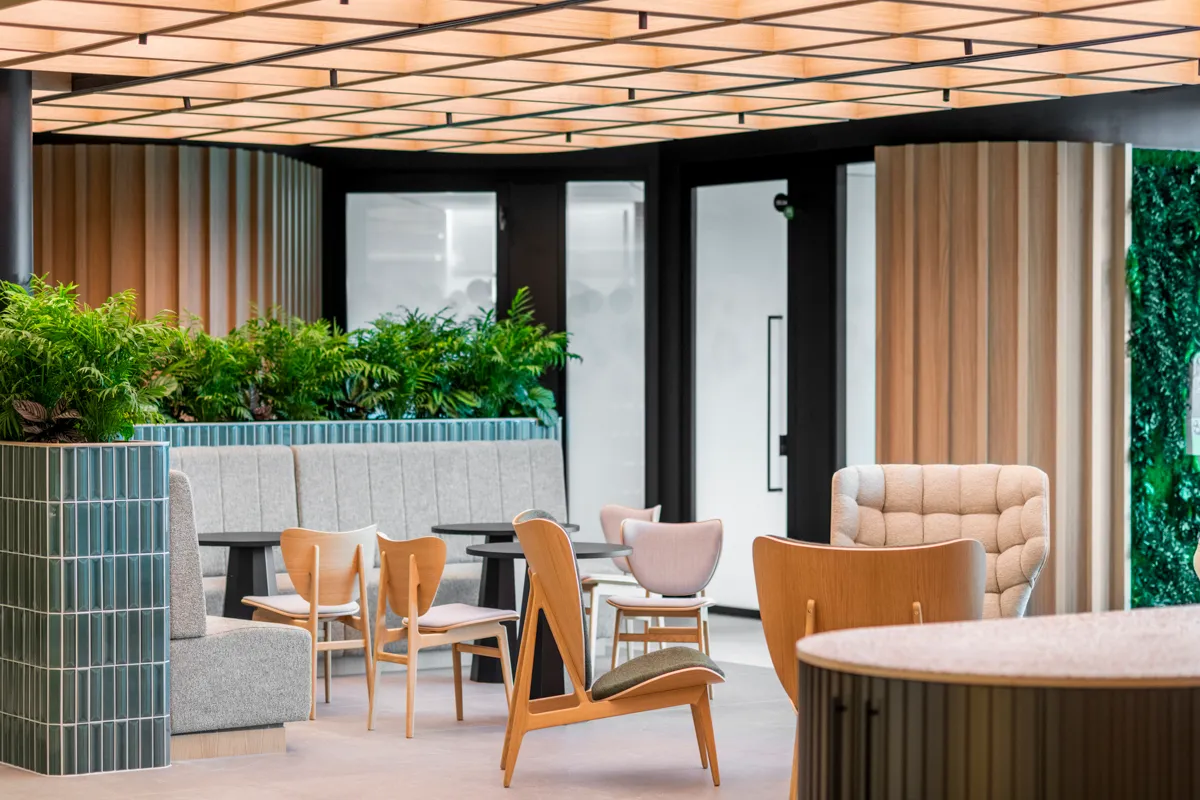
Collaboration isn’t disappearing, but the form it takes is changing.
Many workplaces over-corrected by removing desks and adding open collaboration spaces. The result: too much noise, too little control, and a sense that you must be “on” all day.
The 2026 direction is different: collaboration becomes smaller-scale, easier to book (or not book), and less intrusive.
Trend 1: Smaller-scale collaboration settings
Instead of designing for constant big workshops, organisations are investing in:
2–4 person tables
1:1 mentoring setups
Small team huddle points close to team neighbourhoods
These settings support quick problem-solving without turning the whole day into meetings. Workplace communities such as WORKTECH Academy regularly discuss the rise of mentoring, social learning, and the need for informal collaboration settings that don’t require formal rooms.
Trend 2: Furniture that supports mentoring and community
Mentoring is not just a meeting type, it’s a relationship behaviour. Furniture that supports it tends to be:
Comfortable but not overly casual
Quiet enough for sensitive conversation
Positioned in semi-private zones that still feel safe and visible
Trend 3: Acoustic control built into furniture
Instead of relying only on walls and ceilings, 2026 collaboration furniture often includes:
Acoustic surrounds
Screens
Integrated soft surfaces that absorb sound
This aligns with broader insights from workplace research, including Steelcase perspectives on collaboration dynamics and fatigue (see Steelcase research).
Trend 4: AV-integrated pieces that don’t dominate
Hybrid collaboration isn’t going away. But “tech as a monument” is. 2026 furniture integrates AV more subtly:
Power and data integrated into tables without messy cabling
Camera-friendly layouts that don’t feel like a studio
Displays that can be present without controlling the entire room aesthetic
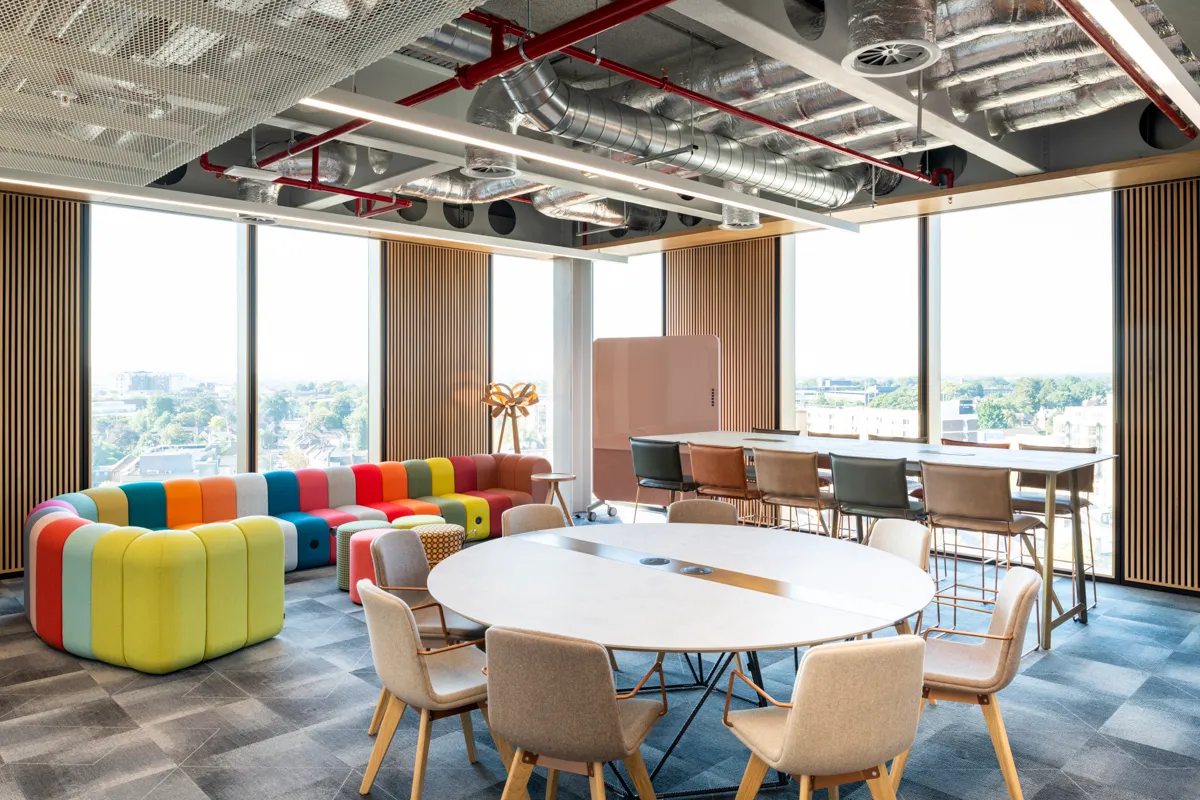
5) Modular furniture as future-proofing, not flexibility theatre
Modularity has been marketed for years. In 2026, the difference is why it’s being adopted.
“Flexibility theatre” is when an office looks adaptable but can’t change cheaply, quickly, or without disruption. Real modularity is systems thinking applied to furniture, so changes in headcount, project mix, or team structure don’t force a refit.
Workplace and real estate thinking from firms like JLL increasingly frames adaptability as a resilience strategy. Meanwhile, the Ellen MacArthur Foundation popularises systems and circular thinking that apply directly to how furniture is designed, purchased, maintained and reused.
Trend 1: Furniture specified as systems, not one-off products
Instead of “choose a desk” and “choose a chair,” teams specify:
Desk + power + storage + screens as a kit-of-parts
Seating families that scale across settings
Common finishes and components that simplify maintenance
Trend 2: Modular desks, seating and storage
Look for:
Benching that can be split into individual desks
Storage that can move from personal to shared use
Soft seating that can be reconfigured without reupholstery
Trend 3: Furniture that evolves with teams
The best 2026 modular systems accommodate:
Changes in team adjacency
More project-based working
Temporary spikes in occupancy
Shifts in accessibility needs
This is one of the most commercially relevant office furniture trends because it reduces lifecycle cost and reduces waste, especially when paired with refurbishment strategies (next section).

6) Circular furniture becomes a commercial expectation
Circularity is moving from “sustainability bonus points” to procurement expectations.
In 2026, many clients will ask not only “what is it made of?” but:
How long will it last?
Can it be repaired?
Can it be reupholstered?
Are components replaceable?
What happens at end of life?
Guidance and advocacy from organisations such as the UK Green Building Council and the Ellen MacArthur Foundation support the broader shift towards circular economy models, reducing waste through reuse, repair, refurbishment, and smarter design.
Circular furniture trends that matter in 2026
Reupholstery and refurbishment over replacement: extending the value of high-quality frames
Replaceable components: arms, casters, covers, power modules, worksurfaces
Longer product lifecycles as standard: warranties and service models become differentiators
Take-back and remanufacture options: more structured end-of-life planning
There’s also a growing overlap between sustainability and wellbeing: people respond positively to environments that feel healthier, calmer, and less disposable, an idea frequently echoed in wellbeing frameworks like the WELL Building Standard.
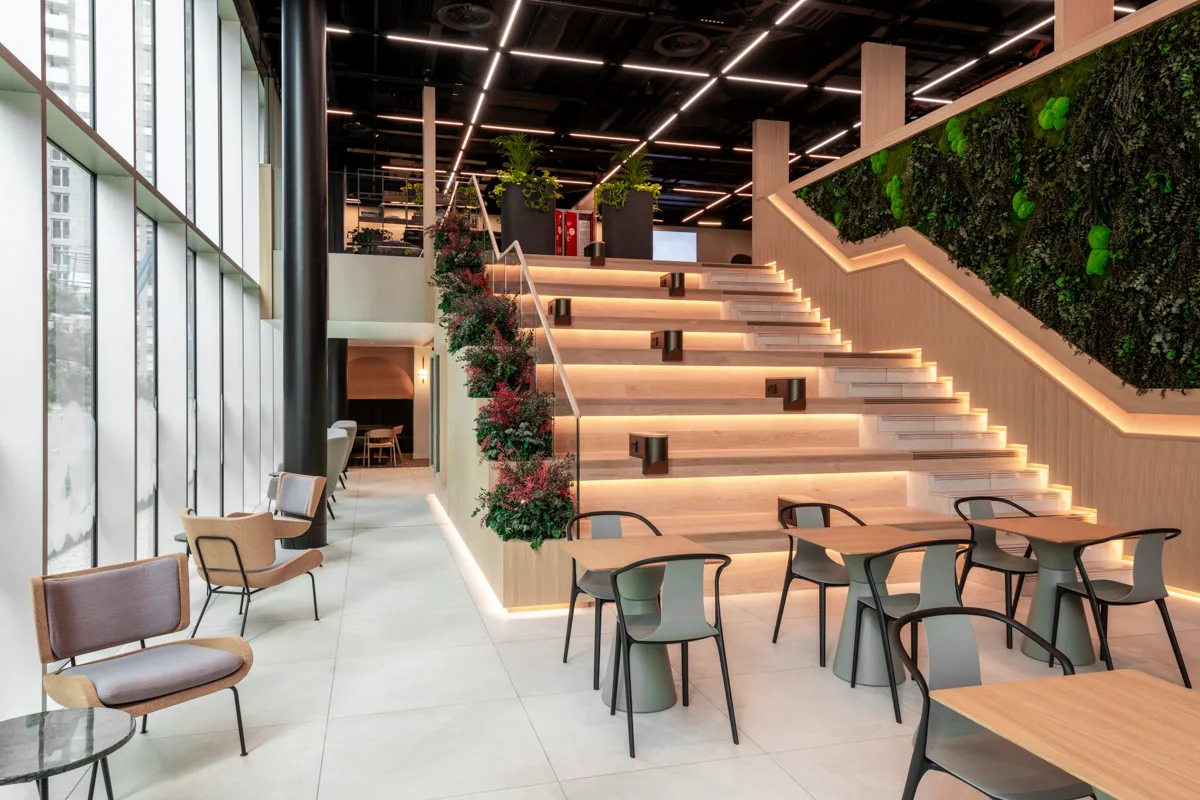
7) Materiality, colour and tactility become performance tools
A key shift in office furniture design trends is the move away from “colour as decoration” towards sensory design as performance support.
People don’t experience a workplace as a floorplan. They experience it through:
Light and sound
Touch and texture
Visual calm (or chaos)
Emotional safety and identity cues
The Leesman Index is often used to gain a better understanding of how workplace experience is relative to satisfaction and perceived productivity; while it isn’t a “colour study,” the emphasis on experience supports the broader argument: emotional response is not a soft metric, it affects whether people want to use the office well.
The WELL Building Standard also reinforces the idea that sensory environments matter, comfort is multi-factorial.
2026 material and finish trends
Earthy, restorative palettes: warm neutrals, muted greens, clay tones, deep blues
Natural materials and tactile finishes: wood grains, textured laminates, woven fabrics, softer-touch surfaces
Reduced glare and harsh contrast: especially important for screen-heavy work
Brand storytelling through furniture: using materiality to communicate values (craft, sustainability, innovation, local identity)
Practical guidance: avoid “Instagram office” mistakes
In 2026, the risk isn’t being boring, it’s being overstimulating:
Too many bright feature colours can increase distraction
Highly reflective finishes can amplify glare and fatigue
Overly “resimercial” lounges can reduce posture support and lead to discomfort
The best approach is consultancy-led. Align materials to work modes, neurodiversity needs, maintenance realities, and brand tone, not trends for their own sake.
8) AI-ready furniture quietly reshapes offices
AI is changing what work looks like at the desk: more drafting, summarising, analysing, iterating, reviewing, often across multiple windows and devices. The physical consequences are straightforward: more screen time, more peripherals, greater power and data demands, and a greater need for ergonomic reliability.
Research and commentary on AI’s impact on work from sources like MIT Sloan and McKinsey’s Future of Work Insights support the macro shift: roles are being redesigned, tasks are being augmented, and productivity expectations are changing. Furniture must keep up without turning the office into a gadget showroom.
Meanwhile, workplace communities, frequently explore smart buildings and data-led design, both relevant because furniture is increasingly part of the “building interface.”
AI-ready furniture trends for 2026
Increased power and data integration: more outlets where people actually sit (not just walls), with easy service access
Screen-heavy support: deeper desks, better monitor arms, camera-friendly setups, controlled lighting positions
Invisible tech, not gimmicks: integrated charging, discreet cable routes, modular power “spines”
Furniture that supports privacy and concentration, especially when work includes sensitive information or intensive thinking
Sensors and utilisation data (where appropriate): used ethically to improve space performance, not police attendance
The key principle: technology should disappear into reliability. If people notice the tech, it’s often because it’s failing, awkward, or dominating.

9) What does this mean for organisations specifying furniture in 2026?
Trends are only useful if they change decisions.
Here are the core implications for the 2026 furniture specification:
1) Furniture decisions lock in behaviour
If you remove desks, people stop doing focused work in the office.
If you provide only open collaboration areas, noise becomes the default.
If you add variety but no reliability, people still feel unsettled.
Furniture silently sets the “rules” of work.
2) Poor furniture choices undermine wellbeing and performance
This isn’t just about back pain. It’s about:
Cognitive fatigue from constant sensory load
Reduced inclusion if only one way of working is supported
Lower productivity if power, screens, and ergonomics are inconsistent
3) The best specs are consultancy-led, not trend-chasing
A practical, evidence-led approach in 2026 looks like:
Define work modes and team patterns first (focus, mentoring, collaboration, routine)
Map those modes to a furniture ecosystem (desk zones, focus seating, small collab, quiet points)
Specify modular systems with lifecycle plans (repair, refurbishment, component replacement)
Align finishes to sensory performance, brand, and maintenance realities
Validate against ergonomics guidance and wellbeing frameworks where relevant
In summary, furniture is the quiet driver of human potential
The most effective workplaces in 2026 won’t necessarily look futuristic. They’ll feel supportive, adaptable and human, because the furniture will be doing the invisible work: reducing friction, enabling choice, supporting inclusion, and sustaining performance.
In an AI-accelerated world, furniture becomes more, not less, important. As work becomes more cognitive, the workplace must protect the conditions that allow people to think clearly: comfort, control, privacy when needed, community when wanted, and environments that don’t exhaust the senses.
That is the real story behind office furniture design trends 2026: not a new aesthetic, but a more mature, research-led understanding that furniture is where workplace experience becomes real.
If you’re looking to unlock the full potential of your office space in 2026,get in touch with our expert team at Sketch Studios. We provide expert-led office furniture consultancy and furniture procurement services that ensure your office is not just up-to-date with this year’s trends but ahead of the curve.
Published on
January 5, 2026