How hospitality is inspiring office furniture

Written by
Gareth van Zyl
Contents
How hospitality-inspired office design is reshaping modern workplace furniture
There was a time when office furniture did one thing: it filled a floorplate efficiently. Desks in rows. Meeting rooms along the edge. Breakout space as an afterthought.
That model no longer holds up.
With hybrid working firmly embedded, offices are no longer default destinations. They have to offer something people cannot get at home. Microsoft’s latest Work Trend Index highlights how flexibility and meaningful in-person interaction now shape employee expectations of the workplace.
That shift is where hospitality-inspired office design enters the conversation, not as a stylistic trend, but as a practical response to changing behaviour.
Hospitality has always been designed for choice. Guests can leave. Diners can decide not to return. Hotels understand that comfort, atmosphere and flow directly affect loyalty and revenue. Increasingly, workplaces are borrowing that mindset.
What does workplace hospitality mean?
Workplace hospitality is often reduced to soft seating and a better coffee machine. In reality, it runs much deeper than that.
It is about applying hospitality design thinking to workplace environments. That means considering how people arrive, where they naturally gather, how long they stay in certain areas and what makes a space feel intuitive rather than forced.
It is less about style and more about experience.
Spatial decisions are always tied to operational performance. The same discipline is now shaping workplace design.

How can we learn from hospitality when procuring furniture for an office space?
Designing for how people actually behave
Traditional offices were built around predictability. People arrived at the same time, sat at the same desk and worked in the same way.
That uniformity no longer reflects how work happens.
Hospitality environments are carefully tuned to human behaviour. Restaurants manage dwell time. Hotels are designed for calm transitions between public and private spaces. Bars orchestrate movement and interaction without people consciously noticing.
Modern workplace design is beginning to do the same. Instead of asking “Where do we put the desks?”, the more useful question is “What behaviours do we want to support?”
Focus. Collaboration. Informal conversation. Quiet retreat.
This shift aligns with the principles behind activity-based working, which recognises that different tasks require different spatial settings.
Furniture plays a central role in enabling those modes without relying solely on fixed partitions.
From uniformity to variety
One of the clearest shifts in office furniture trends is the move away from repetition.
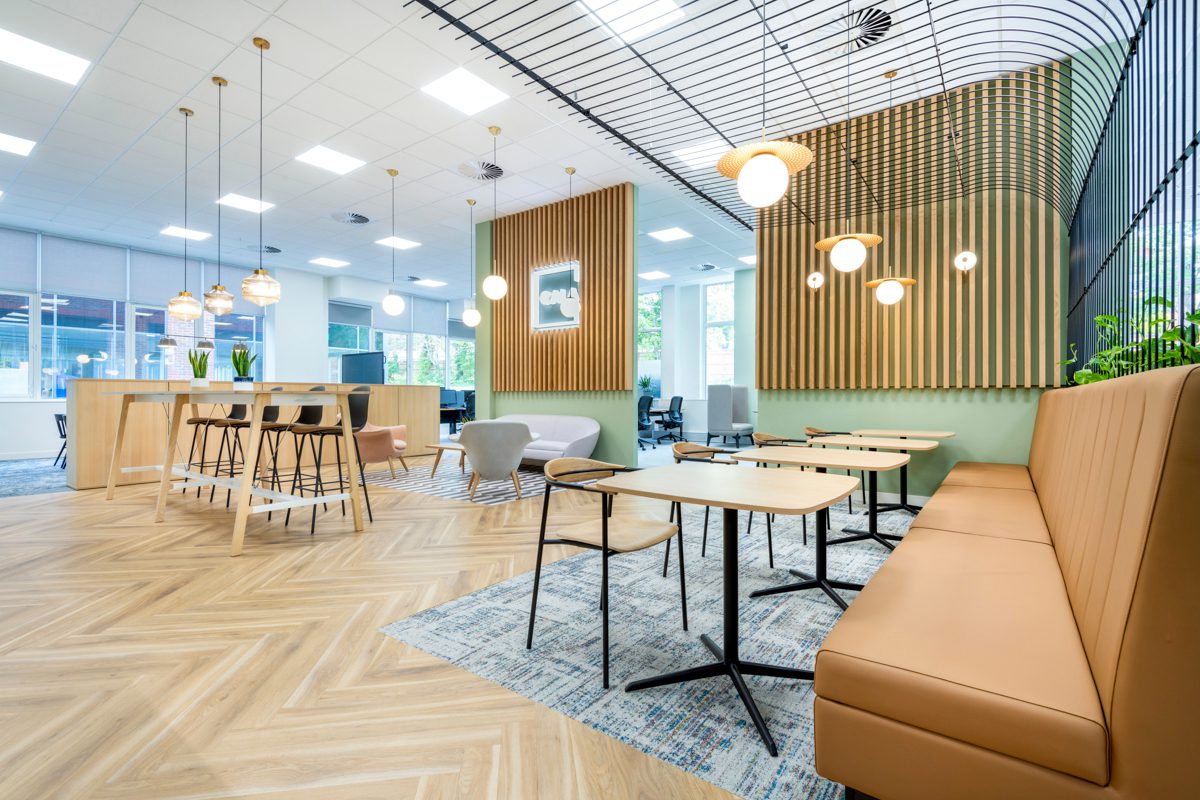
Where offices once specified identical workstations across entire floors, we now see a deliberate mix of settings. Lounge seating sits alongside task chairs. Banquette-style booths offer semi-private meeting space. High tables provide quick touchdown points. Modular elements can be reconfigured as teams change.
This is not aesthetic experimentation. It is a practical response to hybrid working and changing collaboration patterns.
Research from Leesman, which measures workplace experience globally, consistently shows that access to varied work settings correlates with higher workplace effectiveness.
Hospitality has long understood this principle. A well-designed restaurant does not feel monotonous, even within a compact footprint. Offices are catching up.
Comfort is not a luxury
In hospitality, discomfort is expensive. If a chair is poorly proportioned or a space feels acoustically harsh, guests leave sooner than intended.
The workplace equivalent is disengagement.
The World Green Building Council has published research linking elements such as thermal comfort, lighting and acoustic quality with improved wellbeing and performance in offices.
That is why we are seeing a shift towards softer forms, warmer materials and more considered workplace seating solutions. Upholstery is no longer purely functional. Materials are selected for both durability and tactility. Acoustic performance is integrated into furniture itself rather than treated as a separate problem.
Hospitality thinking reminds us that people notice how a space makes them feel, even if they cannot articulate why.

Furniture as part of the architecture
Another lesson from hospitality, is that furniture is never an afterthought. It is part of the spatial infrastructure.
In many modern workplaces, furniture now defines zones instead of walls. A shift in seating type signals a change in activity. A change in height suggests a different pace. Soft boundaries replace hard divisions.
This approach supports fluid movement and makes spaces adaptable over time. It also requires careful planning at the workplace fit out stage. Decisions about furniture influence circulation, acoustics, and even building services.
Bringing hospitality insight into workplace design helps ensure those decisions are coordinated rather than cosmetic.
Durability and operational reality
There is also a less glamorous side to hospitality influence: resilience.
Restaurants, hotels and bars are high-intensity environments. Furniture must withstand heavy use, cleaning regimes and constant reconfiguration. Materials are chosen for longevity as much as appearance.
As offices become more social and less desk-bound, they too experience concentrated peaks of use. Shared seating areas, collaborative hubs and informal lounges require robust specification.
Drawing on hospitality design and hospitality fit out expertise brings a level of operational awareness that benefits workplace projects. It ensures that what looks inviting on day one still performs several years later.
Beyond café culture
There is a risk, of course, in taking the hospitality analogy too literally.
An office is not a hotel lobby. Productivity, focus and privacy remain critical. Acoustic control and ergonomic performance cannot be sacrificed for atmosphere.
The most effective hospitality-inspired office design borrows principles, not aesthetics. It understands why certain environments feel welcoming and translates that insight into a workplace context.

The lines between sectors are blurring
The influence runs both ways. Hotels now incorporate co-working lounges. Offices introduce concierge-style services and curated communal areas. Commentary from the Workspace Design Show highlights how hotel-inspired amenities are increasingly shaping workplace expectations.
For organisations planning a workplace fit out, this cross-sector perspective is increasingly valuable. It allows furniture and interior decisions to be informed by a broader understanding of how people experience space.
In summary
Hospitality-inspired office design is not about surface-level comfort. It is about recognising that workplaces, like restaurants or hotels, rely on people choosing to spend time there.
Furniture is one of the most visible and influential elements in that equation. When specified thoughtfully, it can support collaboration, focus, wellbeing and brand identity at the same time.
At Sketch Studios, we approach workplace design and procuring office furniture with an understanding of operational performance as well as atmosphere, ensuring spaces are not only welcoming but commercially sound.
If you are rethinking your workplace, looking for furniture procurement or in need of furniture consultancy, our team can help you shape an environment that works for you.
Published on
June 2, 2026


